“The Energy Transition, driven by the imperative to significantly reduce fossil fuel reliance, is a global concern that transcends national and economic boundaries. Addressing it requires urgent technical and social innovations embedded within comprehensive strategies to deliver sustainable energy solutions that benefit all stakeholders across the value chain” (Hulst C.A., 2025, A Framework for Universal Energy Inclusion).
There is no consistent definition of Energy Inclusion across institutions or academic literature. Although it appears in social science literature discussions of the Energy Transition, it remains insufficiently examined and inadequately integrated. Energy Inclusion refers to the principle and practice of ensuring equitable access to energy resources, technologies, and benefits for all individuals and communities. It encompasses efforts to address energy poverty, expand access to clean and sustainable energy for underserved populations, and integrate the diverse needs of different groups into energy planning, policy, and innovation. At its core, Energy Inclusion seeks to make the energy transition fair, participatory, and socially responsive, so that no one is left behind in the shift toward sustainable energy systems.
The Levelized Energy Inclusion Model (LeiM) ©2024

To bridge the gap created by the absence of a uniform definition of Energy Inclusion, I developed a conceptualised global benchmarking framework based on the various Energy Inclusion definitions encountered in the literature: the Levelized Energy Inclusion Model (LeiM)© 2024. This two‑factor, nine‑level model establishes Key Performance Indicators at each stage, enabling measurable progress toward true Energy Inclusion. All indicators are grounded in publicly available, reputable data from leading (non)governmental institutions such as the World Bank, OECD, and the UN. The performance indicators selected for the Levelized Energy Inclusion Model (LeiM)©2024 are designed to be SMART*. Each indicator is directly relevant to, and representative of, one of the nine Energy Inclusion definitions. They are measurable, updated on an annual basis, and the scoring methodology assures that progress toward real Energy Inclusion is achievable.
*SMART; Specific, Mesurable, Achievable, Relevant, Time-Bound.
Advancing true Energy Inclusion requires attention to several essential elements. These foundational “hygiene factors” support progress by reducing environmental pollution, expanding access to energy, and strengthening related infrastructure. Building on this foundation, the LeiM© introduces “purpose factors” designed to maximize Energy Inclusion. These focus on participation and empowerment in the energy transition, fair distribution of benefits and burdens, and ensuring energy remains affordable for all.
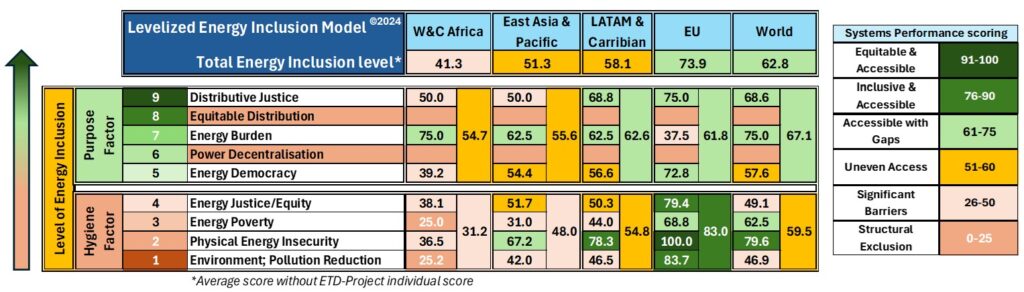
Each of the nine LeiM levels will be described in detail, and the 2024 average of scored countries from two benchmarking regions, the European Union (EU) and the global aggregate (“World”), are presented for illustrative purposes to demonstrate the application of the LeiM© scoring methodology.

LeiM level 1; Environment; Pollution Reduction
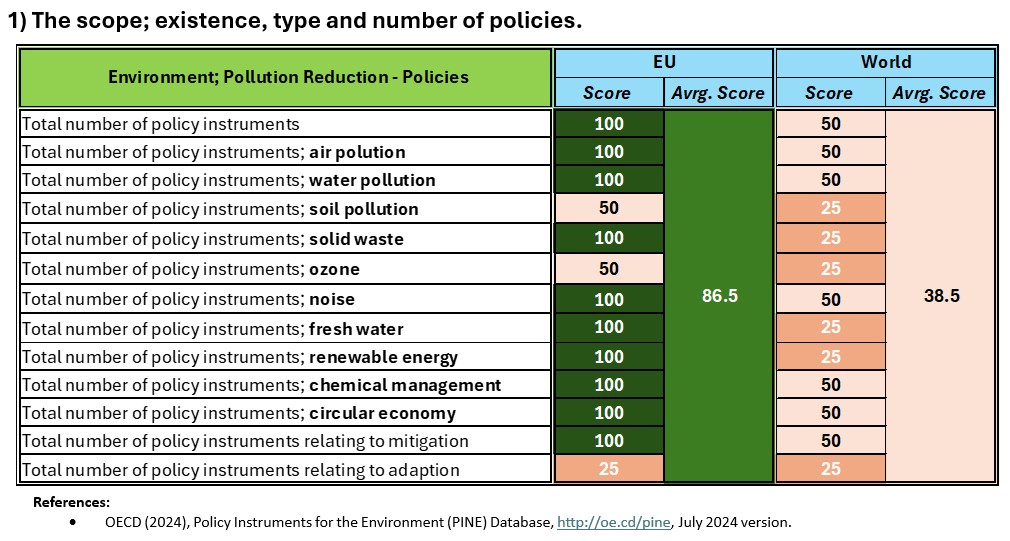
The primary driver of the global Energy Transition is the environmental impact of fossil fuels, thereby harming public health, threatening biodiversity, and intensifying climate risks such as floods and droughts. Energy Inclusion must go beyond electricity access alone, ensuring renewable energy supports socioeconomic development for individuals, businesses, and communities. Strong government policies and regulations are essential to safeguard the environment and public health, as industries often externalise costs and undervalue natural resources. The literature identifies three principal domains of effective government policy, which are reflected in the below three Key Performance Indicator (KPI) scoring tables.
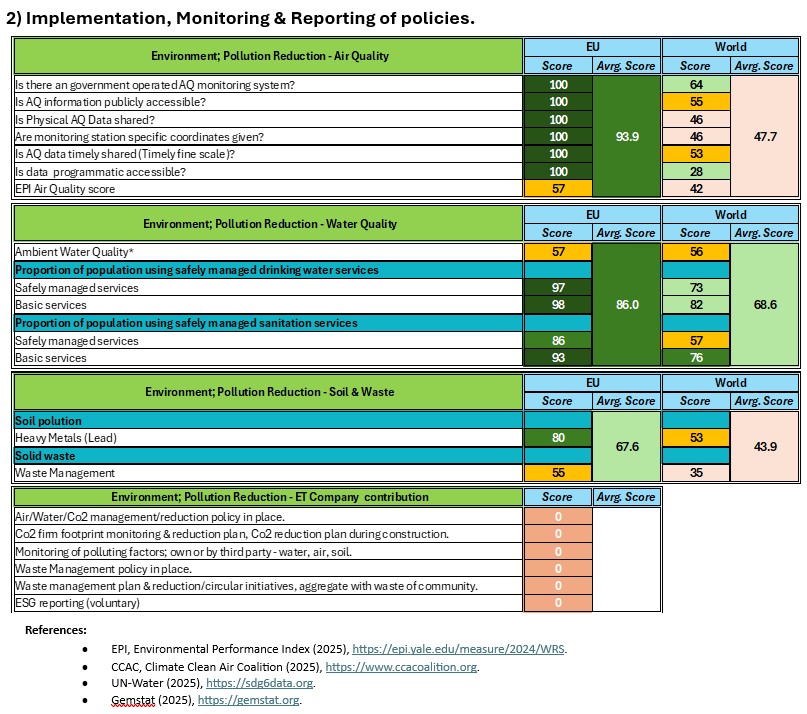
Translating Energy Inclusion from policy design into practical implementation requires companies and projects to operationalise regulatory and policy-driven initiatives. Although many of these measures are mandated by regulation, companies can improve their performance by reporting voluntary and complementary corporate environmental policy actions undertaken at the business level (Table; ET Company contribution). Scoring is taken on a scale of 1 to 100, reflecting the level of the operationalisation project.

LeiM level 2; Physical Energy Insecurity
Energy Insecurity is a Multidimensional Challenge.
Energy Insecurity is not a single issue, it’s a complex, multidimensional condition shaped by economic, physical, and behavioural factors:
- Economic Energy Insecurity refers to the disproportionate financial burden households face in meeting their energy needs.
- Physical Energy Insecurity includes three components:
- Technical: Poor housing infrastructure that undermines thermal comfort, increases exposure to health risks, and drives up energy costs.
- Availability: Limited and reliable access to energy sources.
- Utilisation: Constraints in the capacity of available energy.
- Behavioural Energy Insecurity captures the coping strategies people adopt to manage economic and physical energy stress, often at the expense of their health and well-being.

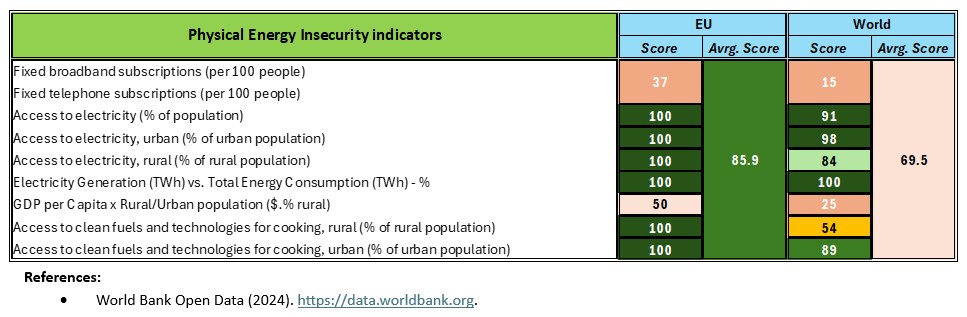
Together, these dimensions reveal how energy insecurity affects lives far beyond utility bills. It shapes health outcomes, deepens inequality, and signals where inclusive energy solutions are most urgently needed. The LeiM 2 framework covers the technical domain and assesses three key dimensions: the robustness of a countries overall electricity grid infrastructure, the population’s access to electricity and clean fuels, and housing infrastructure quality, inferred from fixed communication access. Across countries, higher levels of urbanisation tend to correlate with greater per‑capita income, often reflecting better housing and infrastructure in urban areas. In contrast, lower GDP per capita combined with a larger rural population typically signals poorer housing conditions in rural regions. Because direct rural income data is limited, the GDP per capita divided by the rural population share serves as a useful proxy. A higher ratio suggests stronger rural housing infrastructure.
LeiM level 3; Energy Poverty
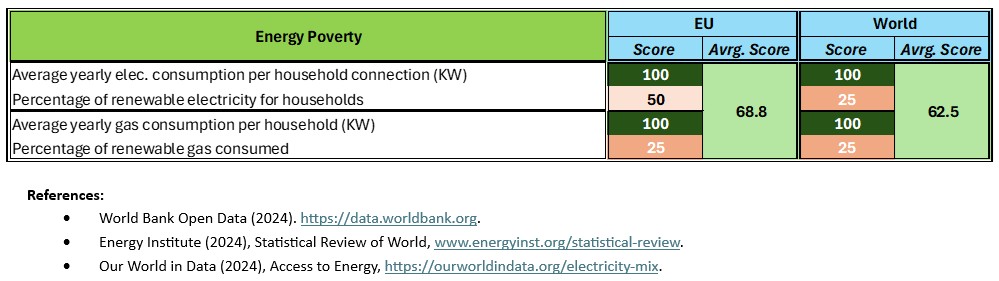
The LeiM 3 framework covers the availability and utilisation of Physical Energy Insecurity. Energy Poverty refers to a lack of energy itself, but next to availability it extends to issues of energy capacity and reliability. To capture this, the average annual electricity consumption per household is used as a key indicator. Electricity drives development, which in turn increases energy demand.Greater electricity use requires larger connection capacity, which is depended on grid and housing infrastructure. Since national-level data on average connection capacity is not publicly available, the LeiM Levels 1 and 2 together reflect electricity reliability as part of its assessment of Energy Inclusion. Monitoring household electricity consumption overtime is also an indication of its reliability. Reliable electricity underpins education, healthcare, and living standards, while also enabling businesses and job creation in the energy sector. Electricity not being the only form of household energy, the average annual consumption of gas per household is also captured in an indicator.
LeiM Level 4; Energy Justice/Equity

Energy Justice and Its Connection to Environmental Justice
Growing evidence shows that social and economic conditions shape how communities experience environmental risks. Marginalised groups are often more exposed to hazards, bear disproportionate costs of environmental policies, and face greater barriers to participating in policy decision-making processes. Energy Justice is closely linked to Environmental Justice and Climate Justice. Environmental Justice focuses on addressing the unequal distribution of environmental risks and benefits across communities, often shaped by race, income, and social status. It seeks to reduce disproportionate exposure to hazards, improve access to environmental amenities, and ensure fair participation in decision-making. Just Transition complements this by ensuring that the shift to sustainable economies is both fair and inclusive, balancing new economic opportunities with the social challenges that arise from the Energy Transition.
Energy Justice builds on this recognition and at its core ensures that no group is unfairly disadvantaged by energy production, distribution, or consumption, and that all people have the opportunity to shape energy policies and systems. The literature highlights three key conceptual pillars:
- Procedural justice is about the fairness in processes and the outcomes. It recognises the importance of how decisions are made, who are involved and influence environmental decisions.
- Recognitional justice is about acknowledging and respecting the distinctive needs, experiences and rights of vulnerable groups in society.
- Distributive Justice is about fairness in the outcomes of Energy Justice. This is an separate indicator captured by LeiM level 9.
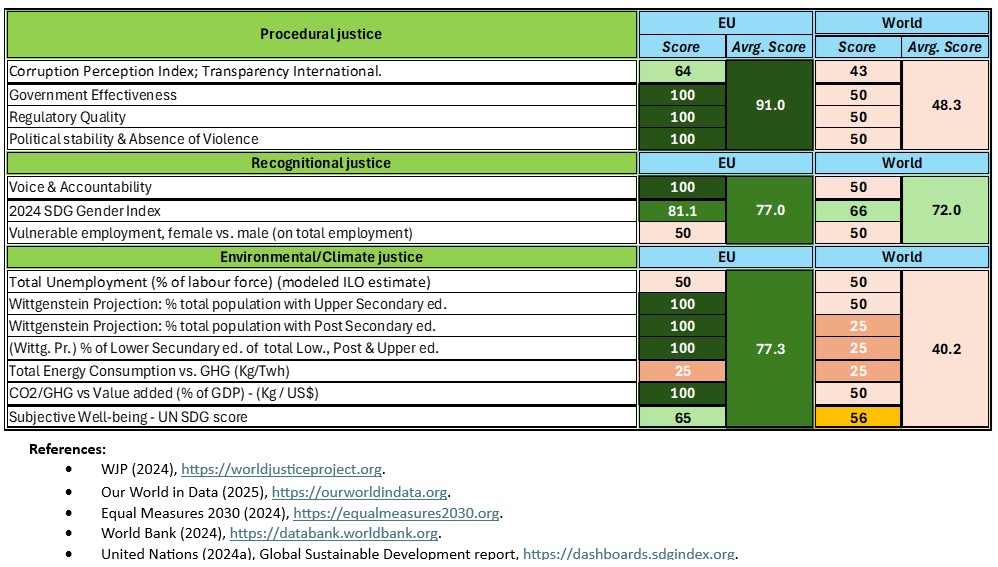
Procedural and Recognition Justice are founded on a nation’s legal system and the rule of law. The indices of the WJP Rule of Law Index of Government Effectiveness, Regulatory Quality, and Voice & Accountability are included. The ratio of male to female vulnerable employment, i.e. informal jobs lacking job security, combined with the UN-SDG Gender Index, provides a measure of a nation’s progress toward gender equality. Environmental/climate Justice, an integrate part of Energy Justice/Equity, share key commonalities across space and time, centring around the core issues of:
- Unequal exposure to environmental hazards: Prevention of environmental hazards is addressed in LeiM level 1, Environment; Pollution Reduction.
- Unfair distribution of the costs and benefits of environmental policies: EU statistical data reveals that extreme temperatures, air and noise pollution, disproportionately affect vulnerable groups, particularly those with lower incomes, less education, and higher unemployment. A nation’s unemployment rate, together with educational indicators, highlight the broader societal impact of these environmental burdens.
- Barriers to accessing environmental information, participating in decision-making and seeking legal rights: Covered in the Procedural and Recognition justice indicators.
- Environmental pollution is assessed through the key indicators greenhouse gas (GHG) emissions, total energy consumption, and economic value added. Together, these measures provide a picture of the overall state of environmental impact.
LeiM Level 5; Energy Democracy
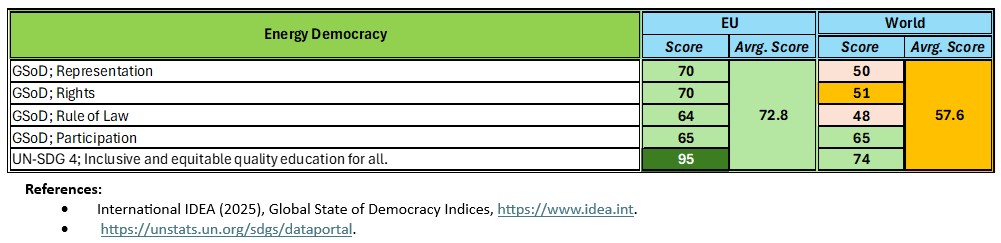
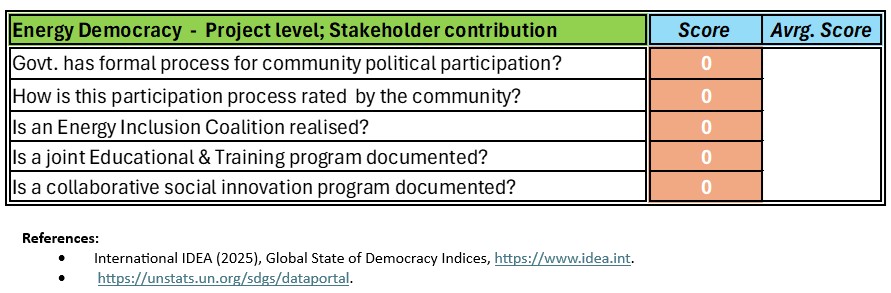
Democratisation in Energy Systems; Energy Democracy is the engaging of the community in energy generation, distribution and transition activities and it can be reached if decision making power and control over the energy system is with the community affected by it. Democratisation can take place in both centralised and decentralised energy systems, extending beyond community projects to include co‑creation, deliberation, and public consultations. Political institutions also serve as arenas where power is contested and democratic change in energy governance can be advanced. Energy Democracy provides a valuable lens for understanding these shifts, though it remains conceptually and practically underdeveloped. To strengthen this perspective, the Global State of Democracy Indices (GSoD) offer a broader, multidimensional assessment of democratic performance. Unlike earlier indicators used in LeiM 4, the GSoD defines democracy as popular control over public decision‑making, combined with equal voice and respect for all citizens. Its measures of participation and accountability are directly relevant to advancing Energy Democracy.

Local Autonomy in Energy Inclusion
True Energy Inclusion requires communities to have a meaningful voice in how energy is sourced, managed, and priced. This involves clear accountability structures, cooperative models, and long‑term participation beyond one‑off consultations. While community involvement at the project level is overlooked in national monitoring, it is essential for advancing inclusion. Establishing an Energy Inclusion Coalition, bringing together investors, governments, and community representatives, creates the foundation for integrating social innovation into energy systems. This integration leads to Social Energy, the succeeding step toward realising full Energy Inclusion.
LeiM Level 6; Power Decentralisation
Decentralisation and Energy Democracy
Power Decentralisation is the Empowerment of those closest to the means of production, geographically, socially and economically.
In economic terms, decentralisation of power means bringing energy generation closer to demand, which does not automatically means Empowerment.
Nevertheless, Power Decentralisation aligns with Energy Democracy, where communities gain ownership and control over energy generation (production), distribution, and transition resources. Energy Democracy’s inclusive governance and shared ownership concepts, strengthen democratic participation and give communities both decision‑making power and entitlement to benefits such as energy access and revenue.
Power Decentralisation encourages local communities to actively participate in energy production projects, enabling them to gain socioeconomic benefits. Practical examples include household solar panels and heat pumps used for self‑consumption. However, for many households, particularly marginalised and vulnerable groups, the upfront financial investment remains a significant barrier to participation.

Community Involvement in Energy Inclusion
Advancing Energy Inclusion requires moving beyond policy and planning into real implementation through democratic participation. At the project level, community involvement is essential. This collaborative stage is built on establishing a formal Social Corporate Responsibility / Social Innovation Committee of key project stakeholders to guide implementation plans, laying the groundwork for the next step: Social Energy. Indicators for Energy Inclusion are at local project level evaluated and included in the overall score.

LeiM Level 7; Energy Burden
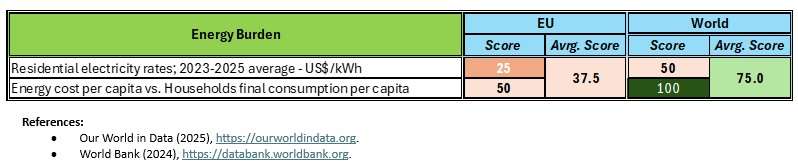
Energy Burden is the cost of energy in relation to the household income. Economic Energy Insecurity arises when these costs place a disproportionate financial strain on low‑income households. By comparing per‑capita energy consumption and electricity rates against household income, an average measure of the overall energy burden can be established, highlighting the affordability challenges.
LeiM Level 8; Equitable Distribution

Equitable Distribution in Energy Inclusion
Equitable Distribution means allocating both the benefits and burdens of energy production, distribution and consumption fairly. LeiM levels 6 and 7 covered fair access to affordable renewable energy, while health and environmental matters were addressed in the LeiM Hygiene Factors. However, Equitable Distribution treats shared natural resources, e.g. water, energy, land, etc. as communal assets to prevent short‑term, profit‑driven overexploitation. It requires cleaning up legacy pollution and remediating contamination from past energy projects and mandates fair compensation, livelihood restoration, or relocation assistance for communities displaced by the Energy Transition Development Project. It also ensures that the financial and social costs of shifting to renewable energy are not disproportionately borne by vulnerable groups.
While many of these issues are addressed through government rules and regulations, highlighting them at the local project level helps prevent future legal challenges. More importantly, it demonstrates commitment and builds trust with community stakeholders, laying the foundation for stronger collaboration in advancing Social Energy.

LeiM Level 9; Distributive justice
Distributive Justice refers to the fairness of resource allocation decisions. Viewed through the lens of Social Innovation (SI) and Social Value, it connects to ethical and moral considerations as well as the evaluation of both economic and social outcomes. In social psychology, it is understood as the perceived fairness in how rewards and burdens are shared among members of a group, shaped by values, beliefs, and ethics.
At the local project level, stakeholders bring their own values and perspectives. These must be carefully surveyed when entering collaborative projects to ensure that Energy Inclusion objectives are aligned and reflect fairness and shared responsibility.
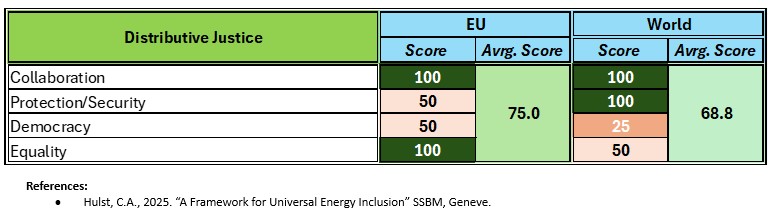
To evaluate if a nation is disposed to maximising Energy Inclusion and Social Energy initiatives, Inglehart and Welzel’s Cultural Map (2025) on countries beliefs and values, Forsyth’s (2006) Ethics Position Theory, and a countries assessment of concurrent national systems (Hulst, C.A., 2025) were combined in an assessment framework.
Energy Inclusion Alignment Framework
To assess whether a nation is positioned to maximise Energy Inclusion and Social Energy initiatives, an integrated framework was developed. It combines Inglehart and Welzel’s Cultural Map (WVS, 2025) on national beliefs and values, Forsyth’s Ethics Position Theory (2006), and Hulst’s (2025) assessment framework of a countries concurrent governance systems.
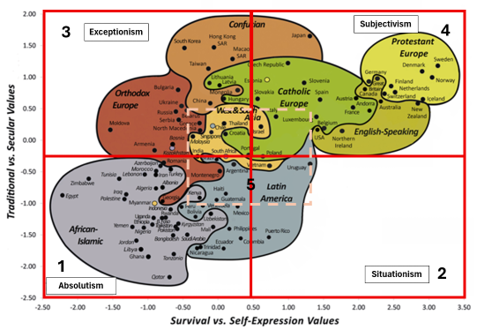

Within this framework, four overlapping themes, Collaboration, Protection/Security, Democracy, and Equality, are scored against regional cultural values and ethical positions to create an Energy Inclusion Alignment Score. This score reflects how well a nation disposes towards Energy Inclusion practices and is the LeiM© indicator for Distributive Justice. Such disposition is expected to evolve gradually in response to shifting political and socioeconomic environments.
LeiM© aggregated Energy Inclusion Level – 2024
Regional Insights on Energy Inclusion
The European Union’s 2024 LeiM score (73.9) exceeds the global average of 62.8, making it comparatively more Energy Inclusive and Accessible. However, its low performance on the Energy Burden (LeiM-7) dimension significantly drags down the Hygiene Factor score, and consequently, the overall 2024 LeiM score. The Latin America and Caribbean region performs close to the global 2024 LeiM levels with improvement opportunities in LeiM level 1 and 3. West & Central Africa, and, to a lesser extent the East Asia & the Pacific region, require a prioritisation on the Hygiene Factors to strengthen this important foundation to be able to scale up Social Innovation & Social Energy initiatives.